Titan Names: Powerful Mythological Monikers from Greek Legend
Titans were the powerful deities who ruled before Zeus and the Olympians took control of the Greek cosmos. These ancient beings, born from the union of Uranus and Gaia, represented fundamental forces of nature and creation.
In Greek mythology, the twelve original Titans included figures like Cronus, Rhea, Oceanus, and Hyperion, whose names continue to inspire characters in games, stories, and creative projects today, especially in themes connected to Greek names.
The war between the Titans and Olympians, known as the Titanomachy, ended with Zeus and his siblings casting most Titans into Tartarus. Despite their defeat, Titans remained essential to Greek mythology’s structure and continue to influence fantasy worlds built around powerful beings such as those featured in giant names.
Some Titans, like Prometheus, played crucial roles in human history. Their children included gods like Apollo, Artemis, and the Muses, while their influence extended to other mythological beings like the Gigantes and creatures comparable in scale to those found in kaiju names.
Choosing a Titan name means connecting with ancient power and primordial forces that shaped the world. This guide explores hundreds of Titan-inspired names across different categories, from traditional mythological options to modern creative interpretations that pair well with bold fantasy surnames.
Whether someone needs a name for a fantasy character, a gaming avatar, or creative inspiration, understanding these legendary figures helps make the right choice, especially when combined with strong warrior names.
Fantasy Titan Names
Fantasy titan names blend mythological elements with creative imagination to produce powerful-sounding identities. These names work well for game characters and epic story protagonists, similar in strength to identities found among dragonborn names.
Writers and game developers often create titan names by combining harsh consonants with flowing vowels. This technique produces names that sound both ancient and memorable.
Fantasy Titan Names:
- Valormath
- Kronethis
- Celestrax
- Hypernox
- Theriagon
- Astrakor
- Typherian
- Oceandra
- Prometheus
- Atlarium
- Metishara
- Phoebron
- Themisara
- Iapethos
- Coeusian
- Tethysia
- Mnemosynth
- Rheavox
Don’t Miss Amazon’s Today’s Deals
Grab the hottest discounts before they’re gone! Explore daily deals, limited-time offers, and exclusive savings on your favorite products — updated every single day.
As an Amazon Associate, I earn from qualifying purchases.
Powerful Fantasy Titan Names:
- Drakonath – A fierce warrior titan with dragon-like qualities
- Vorgrimm – A shadowy titan who guards forgotten realms
- Celestrix – A star-born titan who commands cosmic forces
- Thornaxis – An earth titan covered in stone armor
- Pyroclast – A fire titan born from volcanic eruptions
- Glaciem – An ice titan who freezes entire landscapes
- Tempestros – A storm titan who controls wind and lightning
- Obsidrath – A dark titan forged from volcanic glass
- Titanforge – A craftsman titan who builds mountains
- Voidwalker – A mysterious titan who exists between dimensions
- Ironheart – A metal titan with unbreakable will
- Stormbreaker – A titan who shatters the sky itself
- Earthshaker – A giant whose steps crack the ground
- Nightbringer – A titan who brings eternal darkness
- Skyrender – A winged titan who tears through clouds
- Stonefist – A brutal titan with crushing strength
- Ashenmaw – A destructive titan who breathes ash and fire
Each name suggests specific abilities or characteristics that help define the titan’s role in a story or game.
Titan Girl Names
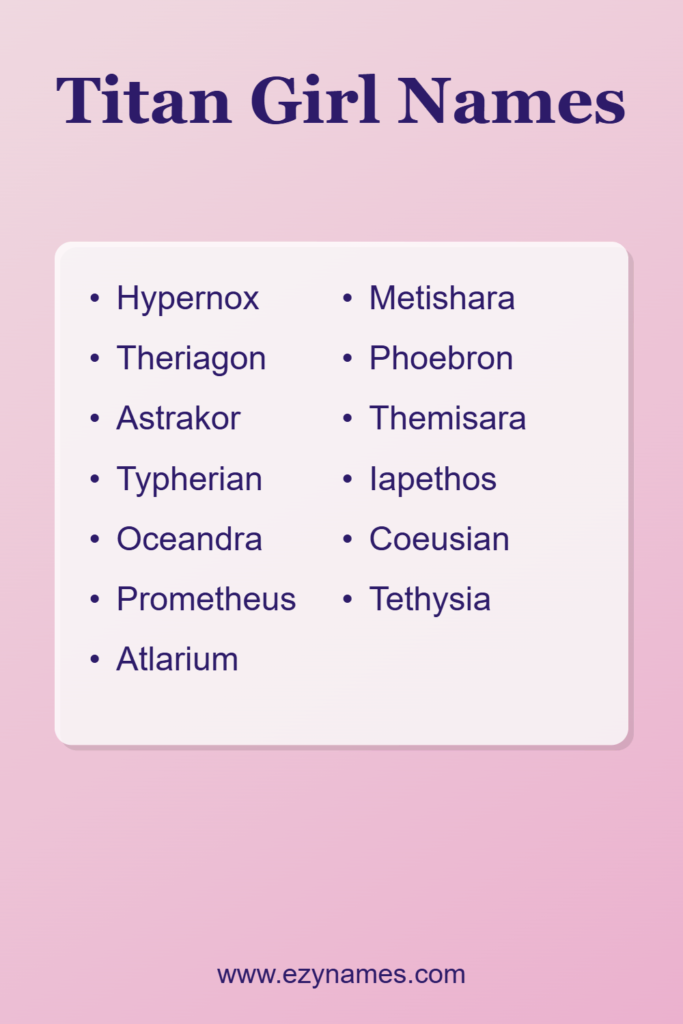
Female Titan names carry ancient power and mythology. These names come from Greek mythology, where the Titanesses were divine beings who ruled before the Olympian gods took control, and they fit naturally alongside powerful girl names
Many of these names belong to the original Titanesses. Rhea served as the mother of the Olympian gods and represented fertility and motherhood.
Theia was the Titaness of sight and light, often associated with precious metals and gems. Phoebe ruled over intellect and prophecy.
She later passed control of the Oracle at Delphi to her grandson Apollo. Mnemosyne was the Titaness of memory and the mother of the nine Muses.
Tethys controlled the waters and nourished the earth. Themis represented divine law, order, and justice.
She often appeared with scales and a sword, symbols later adopted for modern justice. Several Titanesses were associated with the night sky and celestial bodies.
Selene drove the moon across the sky each night. Eos brought the dawn each morning with rosy fingers.
Asteria ruled over falling stars and nighttime prophecies. Other powerful names include:
- Leto – mother of Apollo and Artemis
- Metis – goddess of wisdom and craft
- Dione – an oracle goddess
- Clymene – Titaness of fame and renown
- Styx – goddess of the underworld river
- Hecate – associated with magic and crossroads
- Nyx – primordial goddess of night
These names work well for characters who need strength and ancient wisdom behind them.
Titan Boy Names
Titan names for boys carry a sense of strength and power drawn from ancient mythology. These bold choices stand out from common options and align well with distinctive boy names inspired by history and myth.
Atlas ranks among the most popular titan names. He held the sky on his shoulders in Greek myths.
The name means “to carry” and has gained modern appeal. Prometheus brought fire to humanity and represents intelligence and foresight.
This name suits parents who value wisdom and innovation. It translates to “forethought” in Greek.
Epimetheus served as Prometheus’s brother and means “afterthought.” While less common than his brother’s name, it offers a unique option with mythological roots.
Iapetus was the father of Atlas and Prometheus. He represents mortality and craftsmanship.
The name provides a rare choice for those seeking something distinctive. Helios drove the sun chariot across the sky each day.
His name literally means “sun” and works for boys born during bright summer months.
Additional Strong Options:
- Hyperion – titan of light and father of Helios
- Oceanus – titan of the great ocean river
- Coeus – titan of intelligence and inquiry
- Crius – titan of constellations
- Cronus – leader of the titans
- Theron – means “hunter” with titan-like strength
- Orion – mighty hunter from Greek legends
- Perseus – heroic figure with godlike power
- Evander – means “good man” with ancient roots
- Leander – combines strength with gentleness
Explore Everything & Shop by Interest
From fashion and tech to books and home essentials — Amazon has it all in one place. Start your shopping journey today and discover something new every time you visit!
As an Amazon Associate, I earn from qualifying purchases.
Each name connects to myths about beings of immense power. They offer parents meaningful choices rooted in ancient stories.
Last Name Titan Names
Titan-inspired last names carry a sense of strength and mythological weight. These surnames work well for fictional characters and creative projects, especially when paired with other last names for characters that add depth to world-building.
Some last names draw directly from Greek mythology. Others blend mythical elements with modern naming conventions to create something unique.
Mythological Titan Last Names:
- Kronidas – meaning “descendant of Cronus”
- Hyperion – named after the Titan of light
- Oceanus – inspired by the Titan of the sea
- Themison – derived from Themis, Titan of justice
- Atlantine – connected to Atlas
- Rheavale – combining Rhea with a natural element
- Coeusberg – based on Coeus, Titan of intellect
- Prometheus – the legendary fire-bringer
- Iapetson – linked to Iapetus
- Titanforge – suggesting creation and power
- Mnemosynth – inspired by memory’s Titan
- Criusmere – derived from Crius
- Phoebeson – related to Phoebe
- Tethyson – connected to Tethys
- Asterion – meaning “of the stars”
- Chronworth – time-related heritage
- Dawnbringer – suggesting Eos connections
- Stormheld – weather and power combined
These last names blend ancient roots with clear pronunciation. They maintain the gravitas of Titan mythology while remaining accessible.
Each name suggests heritage tied to primordial forces and ancient power. The surname “Titan” itself carries historical significance rooted in mythology and strength.
Using Titan-inspired last names adds depth to character backgrounds and world-building projects.
Old Titan Names
The first Titans in Greek mythology ruled before the Olympian gods took power. These ancient beings represented fundamental forces of nature and the cosmos, much like figures associated with elemental names traditions.
Their names carry deep historical weight and connection to primordial myths. Cronus (also spelled Kronos) led the first generation of Titans and ruled during the Golden Age.
Oceanus controlled all bodies of water that encircled the world. Hyperion represented light and was father to the sun, moon, and dawn.
Coeus embodied intelligence and inquiry, while his brother Crius ruled over the constellations. Gaia served as the personification of Earth itself and mother to many Titans.
Uranus represented the sky and heavens above. Phoebe held dominion over prophecy and intellect.
Theia governed sight and the blue of the sky. The second generation included warriors and elemental forces.
Pallas fought as a Titan of warcraft and battle. Astraeus controlled the stars and planets.
Perses represented destruction and change. Some Titans ruled over more specific domains.
Phorcys governed the hidden dangers of the deep sea. Eurybia mastered the external seas and their power.
Briareus stood as one of the hundred-handed giants who aided Zeus. These names work well for characters who need ancient authority or primal power.
Each name connects to specific natural forces or cosmic elements from early Greek creation myths.
Funny Titan Names
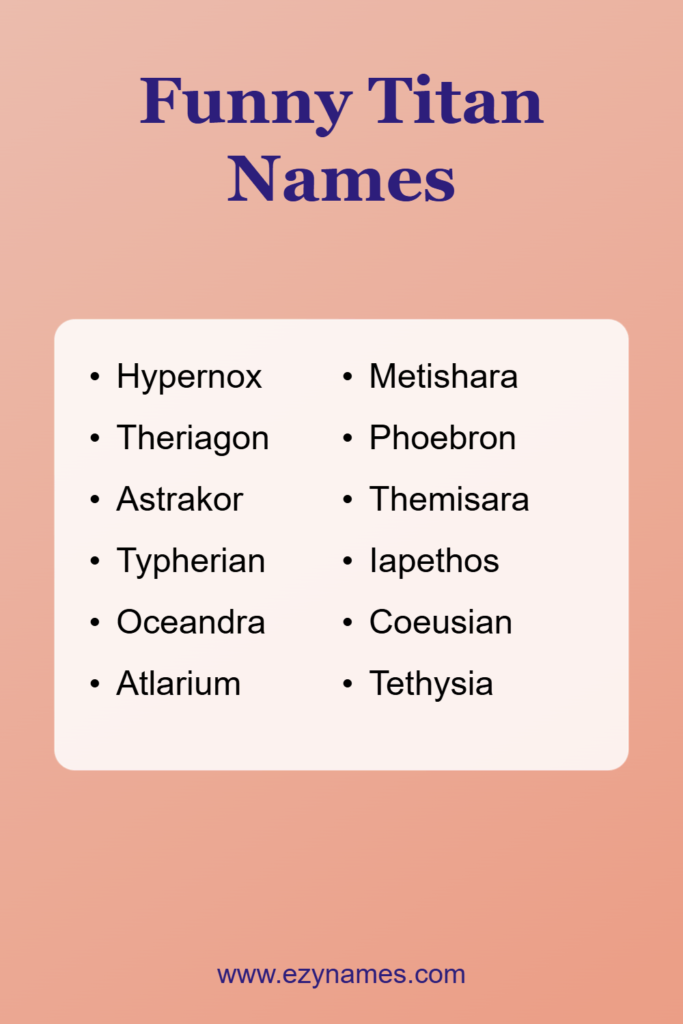
Titans don’t always need to sound serious and intimidating. Some names can bring humor while still capturing their massive size and mythical nature.
Playful Takes on Classic Names:
- Arges the Clumsy – A twist on the original Cyclops Titan who forged Zeus’s thunderbolts
- Ladon’s Leftovers – Inspired by the dragon-like creature who guarded golden apples
- Gration the Giggly – A humorous spin on the giant who fought in the Gigantomachy
- Stumblestone – For a Titan who trips over mountains
- Boulderbeard – A giant with rocks stuck in his facial hair
- Thunderthighs – Self-explanatory physical humor
- Cloudknocker – A Titan who keeps bumping into clouds
- Moonbonker – Known for accidentally hitting celestial bodies
- Pebblesnack – Enjoys munching on small rocks
- Grumblegut – Has a very loud digestive system
- Earthquaker – Their sneezes cause tremors
- Fogbottom – Always has their head in the clouds
- Stormsnorer – Creates weather patterns while sleeping
- Mudsplasher – Leaves messy footprints everywhere
- Cragtooth – Has actual mountain peaks for teeth
- Avalanche-Apologies – Constantly saying sorry for causing rockslides
These names work well for games, stories, or any creative project where a lighter tone fits the setting. They maintain the scale of titans while adding personality through wordplay and amusing imagery.
Modern Titan Names
Modern titan names blend ancient mythology with contemporary appeal. Parents and creators now seek names that carry the strength of Greek titans while fitting into today’s world.
Some families choose titan-inspired baby names for their powerful meanings. Names like Atlas and Rhea work well in modern settings.
These options connect children to mythological strength without being too unusual. Greek titan names have inspired many updated versions.
Thea comes from the titan goddess of light and sight. Cronus can become Crone or Kronos for a fresh take.
Here are modern titan names that work today:
Male Names:
- Hyperion – Titan of light and observation
- Oceanus – Ruler of the ocean streams
- Prometheus – Forward-thinking titan
- Iapetus – Titan of mortality
- Coeus – Titan of intellect
Best Grocery Deals Today
Find amazing daily grocery offers on fresh produce, organic selections, and essential household products at unbeatable prices, helping you save more on every shopping trip.
As an Amazon Associate, I earn from qualifying purchases.
Female Names:
- Selene – Moon titan goddess
- Phoebe – Bright and prophetic titan
- Mnemosyne – Memory and remembrance
- Themis – Order and justice
- Tethys – Fresh water and nursing
Gender-Neutral Names:
- Phoenix – Inspired by titan mythology
- Asteria – Starry titan name
- Dione – Divine queen
- Metis – Wisdom and cunning
- Lelantos – Moving unseen
These names maintain their mythological roots while sounding natural in modern contexts. Each carries the weight of titan heritage without being difficult to pronounce or spell.
Tips On Choosing The Best Titan Names
Picking the right titan name requires thinking about the character’s personality and role. A name should match whether the titan is fierce, wise, or protective.
Consider the Origin and Meaning
Greek and Norse mythology offer strong foundations for titan names. Names rooted in ancient languages carry weight and authenticity.
The meaning behind a name can add depth to a character’s story.
Match Sound to Strength
Powerful titans need names that sound imposing. Hard consonants like K, T, and G create a sense of force.
Softer sounds work better for gentler or mystical titans.
Keep It Memorable
A good titan name should be easy to remember but not too simple. Names between 6-12 characters tend to work best.
Avoid names that are too similar to existing popular characters.
Here are strong titan name examples to consider:
- Kronathos – evokes ancient power
- Valdreira – suggests guardian strength
- Thorgrimm – combines thunder and might
- Aetheron – hints at sky dominion
- Moltenforge – conveys elemental force
- Stormbreaker – direct and powerful
- Titanarex – emphasizes titan nature
- Obsidianfist – dark and unyielding
- Celestrion – cosmic authority
- Ironmountain – unmovable presence
- Vortexius – chaotic energy
- Earthshaker – ground-breaking force
- Nightbringer – ominous power
- Crystalborn – ancient creation
- Flameheart – burning intensity
- Thunderclaw – aggressive dominance
- Shadowtitan – mysterious strength
Arts, Crafts & Sewing Supplies Collection
Explore a wide range of crafting materials, fabrics, tools, and accessories designed to inspire creativity and help you bring your artistic ideas to life.
As an Amazon Associate, I earn from qualifying purchases.
The name should feel natural when spoken aloud. It needs to fit the world or setting where the titan exists.
Frequently Asked Questions
Greek mythology features twelve original Titans who ruled before the Olympian gods. Modern interpretations like ‘Attack on Titan’ reimagine these beings as massive humanoid creatures.
The names carry specific meanings rooted in ancient Greek language. Both mythological and fictional universes present distinct hierarchies of these powerful entities.
What are the names and powers of the 12 Titans in Greek mythology?
The twelve original Titans were the children of Gaia (Earth) and Uranus (Sky).
The male Titans included Cronus, who ruled over time and became king of the Titans.
Oceanus controlled the world-encircling river. Hyperion was the Titan of light.
Coeus was associated with intelligence and inquiry.Crius was linked to constellations.
Iapetus was connected to mortality and craftsmanship.
The female Titans were Rhea, goddess of fertility and motherhood.
Theia was goddess of sight and heavenly light.
Tethys was goddess of fresh water. Themis was goddess of divine law and order.
Mnemosyne was goddess of memory. Phoebe was goddess of prophecy and intellect.
Each Titan governed specific aspects of the cosmos and natural world.
How are the Titans depicted in ‘Attack on Titan’ different from classical mythology?
The Titans in ‘Attack on Titan’ are giant humanoid creatures ranging from 3 to 60 meters tall. They consume humans but do not require food for sustenance.
These beings lack intelligence except for special variants. Classical Titans were divine immortal beings with human-like appearances and full cognitive abilities.
They ruled as gods and possessed wisdom, planning, and complex emotions. The mythological Titans formed families, created alliances, and engaged in sophisticated power struggles.
The anime presents Titans as mindless threats to humanity rather than ruling deities. Only the Nine Titans possess intelligence and special abilities tied to their specific forms.
Can you list notable male figures among the Titans of Greek mythology?
Cronus stood as the leader of the Titans after overthrowing his father Uranus. He wielded a sickle and ruled during the Golden Age.
His paranoia about being overthrown led him to swallow his own children. Oceanus personified the vast ocean that Greeks believed encircled the world.
Hyperion fathered Helios (Sun), Selene (Moon), and Eos (Dawn), making him grandfather to celestial bodies. Iapetus became father to Prometheus, Epimetheus, Atlas, and Menoetius.
Coeus represented the axis of heaven around which constellations revolved. Crius had dominion over heavenly constellations and was father to Astraeus, Pallas, and Perses.
What are the meanings behind the names of the Titans in mythology?
Cronus derives from the Greek word for time, though some scholars connect it to “harvest” or “sickle.” Oceanus comes from the ancient Greek word for ocean or great river.
Hyperion translates to “the high one” or “he who walks on high.” Rhea means “flow” or “ease,” fitting her role as mother goddess.
Themis means “divine law” or “that which is laid down.” Mnemosyne directly translates to “memory.”
Phoebe means “bright” or “pure,” connecting to her association with prophecy and light. Iapetus relates to “piercer” or “wounding,” reflecting his connection to mortality.
These names reflected each Titan’s divine function and cosmic role.
Who were the principal deities that defeated the Titans in mythological accounts?
The Olympian gods, led by Zeus, overthrew the Titans in a conflict called the Titanomachy. Zeus, Poseidon, Hades, Hera, Demeter, and Hestia formed the core group of younger gods.
Zeus freed his siblings from Cronus’s stomach and rallied them to fight. The war lasted ten years and reshaped divine rule.
The Cyclopes forged powerful weapons for the Olympians: Zeus received thunderbolts, Poseidon gained his trident, and Hades obtained a helmet of invisibility. The Hecatoncheires, hundred-handed giants, also aided the Olympians.
After victory, Zeus imprisoned most Titans in Tartarus, a deep abyss below the underworld. Atlas received special punishment, forced to hold up the sky for eternity.
Oceanus and a few others avoided imprisonment by remaining neutral.
What titles are given to the 9 special Titans within the ‘Attack on Titan’ series?
The Nine Titans are unique intelligent forms with distinct powers.
The Founding Titan controls all other Titans and can alter memories of most humans.
The Attack Titan moves forward seeking freedom and can see future memories.
The Colossal Titan reaches 60 meters tall and produces devastating steam explosions.
The Armored Titan possesses hardened skin like protective plates.
The Female Titan excels at hand-to-hand combat and can selectively harden body parts.
The Beast Titan demonstrates animal characteristics and can speak, often appearing ape-like.
The Jaw Titan has powerful jaws and claws for breaking through almost any material.
The Cart Titan maintains Titan form for extended periods and offers exceptional endurance.
The War Hammer Titan creates weapons and structures from hardened material.